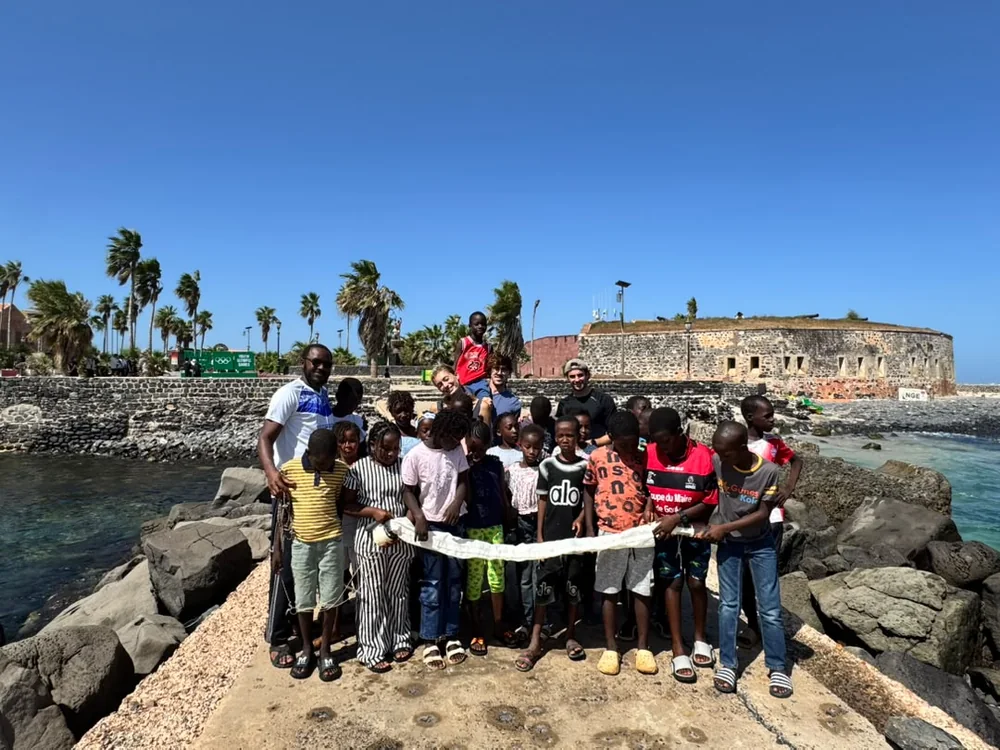
For their second adopt a float session, Gorée’s Young Sentinels met Thomas, Zoé and Paco again for a scientific adventure close to their island. Collecting plankton on the quay, measuring temperature and light in the water, microscope observations and experiments with water layers made for an encounter rich in discovery, wonder and sharing.
On the quay, collecting a sample of invisible life
The ocean is part of everyday life for children in Gorée. This session invited them to look at it on a different scale: that of organisms that are hard to see with the naked eye and can be discovered through scientific observation.
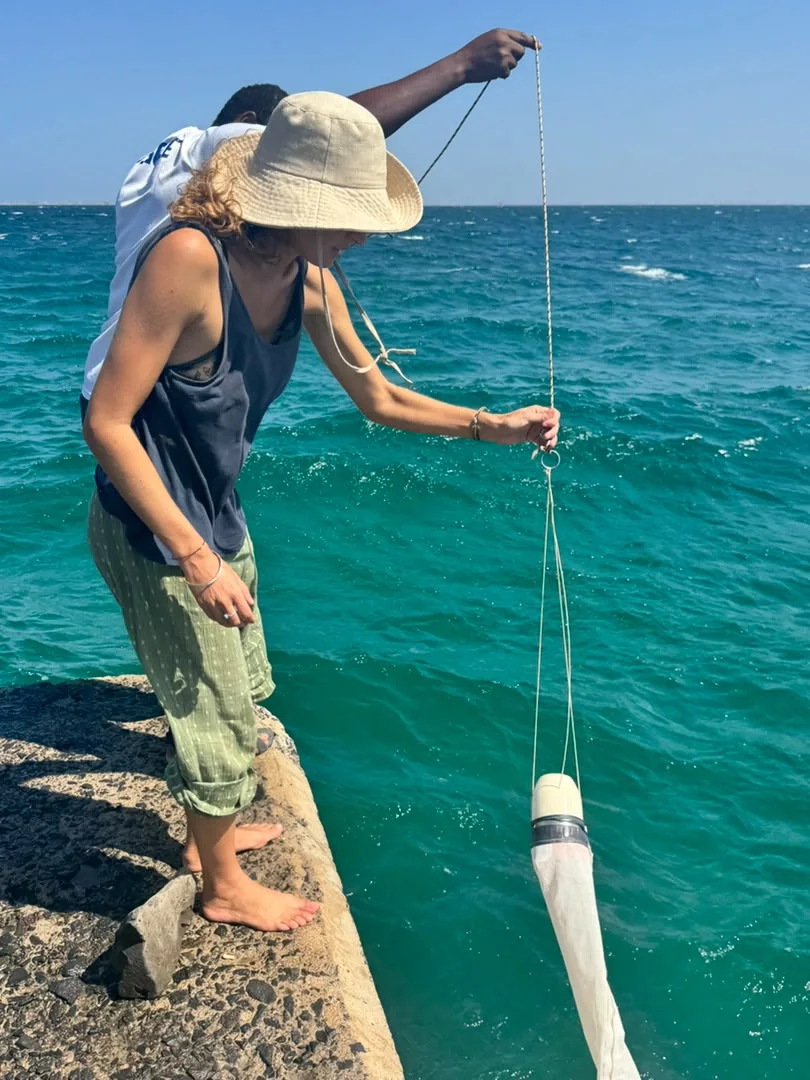
On the quay, collecting samples with a plankton net marked the start of the exploration. Guided by the scientific team, the Sentinels discovered this particular kind of “fishing”, which collects organisms suspended in the water for later observation. The net, the samples and the explanations already connected a practical action with a question: what life is present in the water surrounding our island?
This step gave meaning to the work that would follow. The samples came from their own environment, from the familiar sea whose living world still held discoveries for them.
Taking measurements to understand the marine environment
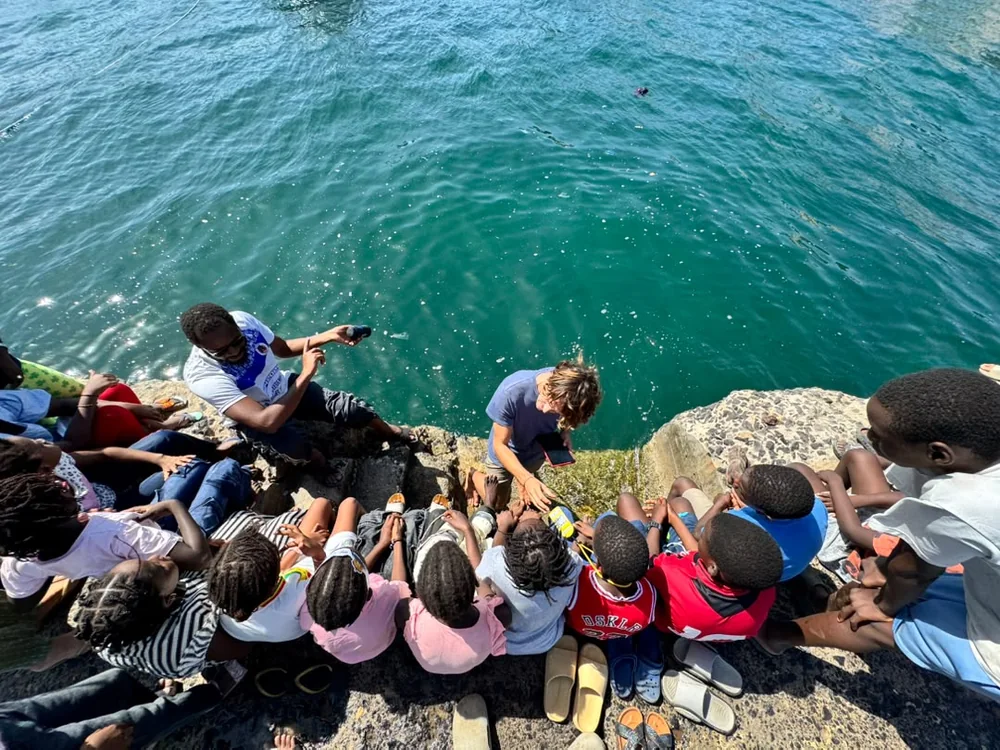
The session also introduced measurements of temperature and light in the water. With Thomas, Zoé and Paco, the children discovered how instruments can add to what we perceive when looking at the sea from the quay.
These activities offered a chance to become familiar with a scientific approach: observing, measuring, comparing and seeking to understand. Temperature and light became reference points for exploring living conditions in the marine environment.
Under the microscope, a living world comes into view
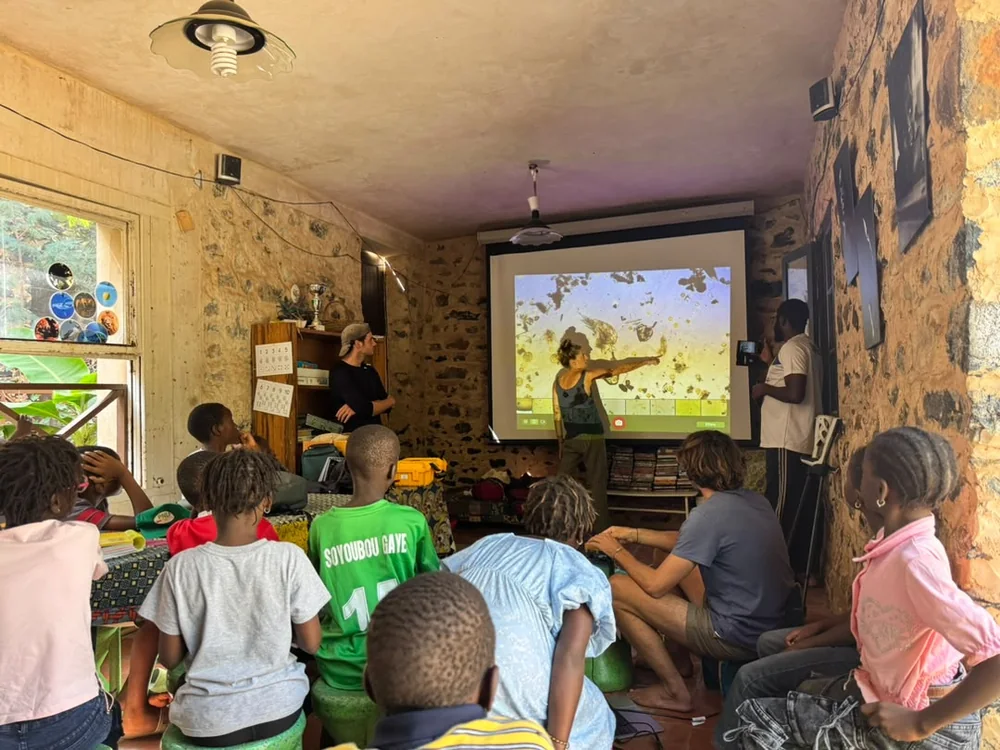
Back in the workshop space, observing the samples under the microscope was one of the highlights of the encounter. Images projected on a large screen allowed everyone to share the discoveries: shapes, movement and an unexpected diversity appeared in the samples.
The children learned to distinguish, among other groups, phytoplankton, often called plant plankton and including microalgae capable of photosynthesis, and zooplankton, or animal plankton, which includes small animals and larvae. These organisms play an essential role in marine food webs.
Finding words for what they observed, noticing differences, returning to an image and listening to an explanation: discovering plankton brought curiosity and attention together. The microscopic world gave Gorée’s sea a new dimension.
Different water temperatures, layers to understand
Experiments exploring layers of water extended the discovery. Through practical activities with water at different temperatures, the team made an initial understanding of thermal stratification accessible.
At comparable salinity, warmer seawater is less dense than colder seawater and can remain above it. Differences in density therefore contribute to the ocean’s layered structure.
The experiment gave this explanation a tangible form. It connected measurements made by the water with phenomena that can be reproduced, observed and discussed together.
A scientific encounter, a human experience
The richness of this second session also lay in the quality of the exchanges. Thomas, Zoé and Paco’s availability, explanations and guidance helped make the encounter accessible, lively and full of emotion.
For the Sentinels, meeting a scientific team gave a human face to research careers. Science was taking place on their quay, in their environment and through the questions they could ask.
Discovery also went both ways. The team encountered Gorée through its distinctive character, its welcome and its local flavours. Shared conviviality extended the conversations and made the day an encounter between people, knowledge and a place.
Nurturing curiosity and care for the ocean
Building on the first session, this new step illustrates GOCEAN’s educational approach: starting with children’s own environment, providing tools for understanding and nurturing their ability to observe and act.
Collecting plankton, taking measurements, microscopy and experiments formed a connected learning journey. The Sentinels could link the field with the workshop, practical actions with explanations, and discovering living organisms with their daily relationship with the ocean.
GOCEAN warmly thanks Thomas, Zoé and Paco for their commitment to the children, as well as the Sentinels, their families and everyone who supported this encounter.
From Gorée, learning to observe the invisible also means learning to care for the living world.
Further reading
On the ground
The story in pictures.
Select a photograph to view it in full.
The Sentinels in the field
A pathway that grows with every encounter.
The launch in Gorée
Reduce plastic, clean, sort, reuse and grow.
Read the story18 July 2026An ecological class in Hann
Learning across generations with Mbacké Seck, the Sentinel of Hann Bay.
Read the storySeptember 2026World Clean Up Day
Collective action with Dak’Clim and discovery workshops facilitated by RECIKIT.
Read the storyNovember 2026Discover ocean science
The adopt a float programme connects the Sentinels’ curiosity with scientific observation.
Read the story